martes, 19 de julio de 2016

Valentine's Day in the United States

What Do People Do?

Many people celebrate their love for their partner by sending cards or letters, giving gifts or flowers and arranging meals in restaurants or romantic nights in hotels. People who would like to have a romantic relationship with somebody may use the occasion to make this known, often anonymously. Valentine's cards are often decorated with images of hearts, red roses or Cupid. Common Valentine's Day gifts are flowers chocolates, candy, lingerie and champagne or sparkling wine. However, some people use the occasion to present lavish gifts, such as jewelry. Many restaurants and hotels have special offers at this time. These can include romantic meals or weekend breaks.

Public Life

Valentine's Day is not a public holiday. Government offices, stores, schools and other organizations are open as usual. Public transit systems run on their regular schedule. Restaurants may be busier than usual as many people go out for an evening with their spouse or partner. Valentine's Day is also a very popular date for weddings.

LOOKING FOR LOVE


141 million Valentine’s Day cards are exchanged annually, making Valentine’s Day the second-most popular greeting-card-giving occasion. (This total excludes packaged kids valentines for classroom exchanges.) (Source: Hallmark research)

Did You Know?

In addition to the U.S., Valentine's Day is celebrated in Canada, Mexico, the United Kingdom, France, Australia, Denmark, Italy and Japan.

Over 50 percent of all Valentine’s Day cards are purchased in the six days prior to the observance, making Valentine’s Day a procrastinator’s delight. (Source: Hallmark research)

Research reveals that more than half of the U.S. population celebrates Valentine’s Day by purchasing a greeting card. (Source: Hallmark research)

There are 119 single men (i.e., never married, widowed or divorced) who are in their 20s for every 100 single women of the same ages. Corresponding numbers for the following race and ethnic groups are:
Hispanics: 153 men per 100 women
Asians (single race): 132 men per 100 women (This ratio is not significantly different from that for Hispanics or non-Hispanic whites.)
Non-Hispanic whites (single race): 120 men per 100 women
Blacks (single race): 92 men per 100 women (The numbers of black men and women in this age group are not significantly different from one another.

There are 34 single men (i.e., never married, widowed or divorced) age 65 or older for every 100 single women of the same ages. Corresponding numbers for the following race and ethnic groups are:
Hispanics: 38 men per 100 women
Non-Hispanic whites (single race): 33 men per 100 women
Blacks (single race): 33 men per 100 women
Asians (single race): 28 men per 100 women

(Note: None of the ratios for the individual groups differ significantly from one another nor from the ratio for all people age 65 or older.)

904: The number of dating service establishments nationwide as of 2002. These establishments, which include Internet dating services, employed nearly 4,300 people and pulled in $489 million in revenues

Source: http://www.history.com/topics/valentines-day/valentines-day-facts

martes, 28 de junio de 2016

Preventing Chronic Absenteeism & Truancy

Posted: Tue, 01/28/2014 - 9:23amUpdated: Thu, 07/09/2015 - 1:17pm
The literature provides numerous recommendations to prevent and/or reduce chronic student absenteeism. Many of these strategies have been implemented in small settings. These programs show considerable promise. However, evidence that these programs are effective at scale (i.e., implemented across a school corporation or across the state) remains limited. Based on the existing research, it does not appear that any single strategy is the most effective strategy (Maynard, et al., 2012). Broadly, the review suggests that strategies to reduce student absenteeism generally involve some form of monitoring, prevention, intervention, and as a final step some type of truancy or legal intervention. Within this broad framework, research identifies specific strategies that can be used by schools, parents, and communities to improve student attendance. Given the limitations of the existing research, it is likely that a combination of strategies must be leveraged to fully address student attendance issues.
Based on the results of this review of the existing literature, it is assumed that an effective student attendance program includes monitoring, prevention, and intervention activities. Monitoring activities should provide schools with accurate and timely information to effectively identify students who are most at-risk of becoming chronically absent. That is, these systems should provide educators with information about student attendance before the student becomes chronically absent. Second, schools and school corporations can take steps to prevent student absenteeism. These prevention activities should be broad-based and designed to educate students, parents, families, teachers, and communities about the importance of consistent school attendance while also creating conditions that incentive perfect or near-perfect attendance. More importantly, prevention measures should also include efforts to provide education and information to students – particularly in the elementary grades - so that they develop an understanding of the importance of regular school attendance. Intervention activities should be strategically focused on students whose attendance is not improving. These interventions should include immediate communication with parents about their son or daughter's attendance as well as follow-up supports that effectively assist students in arriving at school on-time, ready-to-learn. As a final measure, the research indicates that school corporations may benefit from partnerships with community agencies that offer broader access to social services and juvenile justice programs than schools alone can provide. These partnerships enable schools to reach students who are chronically absent, truant, or stopped attending school altogether.

http://www.doe.in.gov/student-services/attendance/preventing-chronic-absenteeism-truancy

The Extent of the Elementary Attendance Crisis


Because California lacks important statewide attendance data, since 213 the Attorney General’s Office has commissioned research to estimate the extent of elementary school absenteeism in California. We use multiple sources of data for this purpose, including: 
Data from Aeries client school districts representing over 350,000 K-5 California students 
Data from over 250 California school districts in on our 2015 district leadership survey
Statewide data on truancy and average daily attendance from the California Department of Education (CDE) 


Through a partnership with Eagle Software and the participation of their Aeries client districts, we have access to a unique dataset that provides detailed information about elementary school absenteeism in California. Data from over 350,000 K-5 students in the state indicate that high levels of elementary school absenteeism continue to be a serious problem in California.


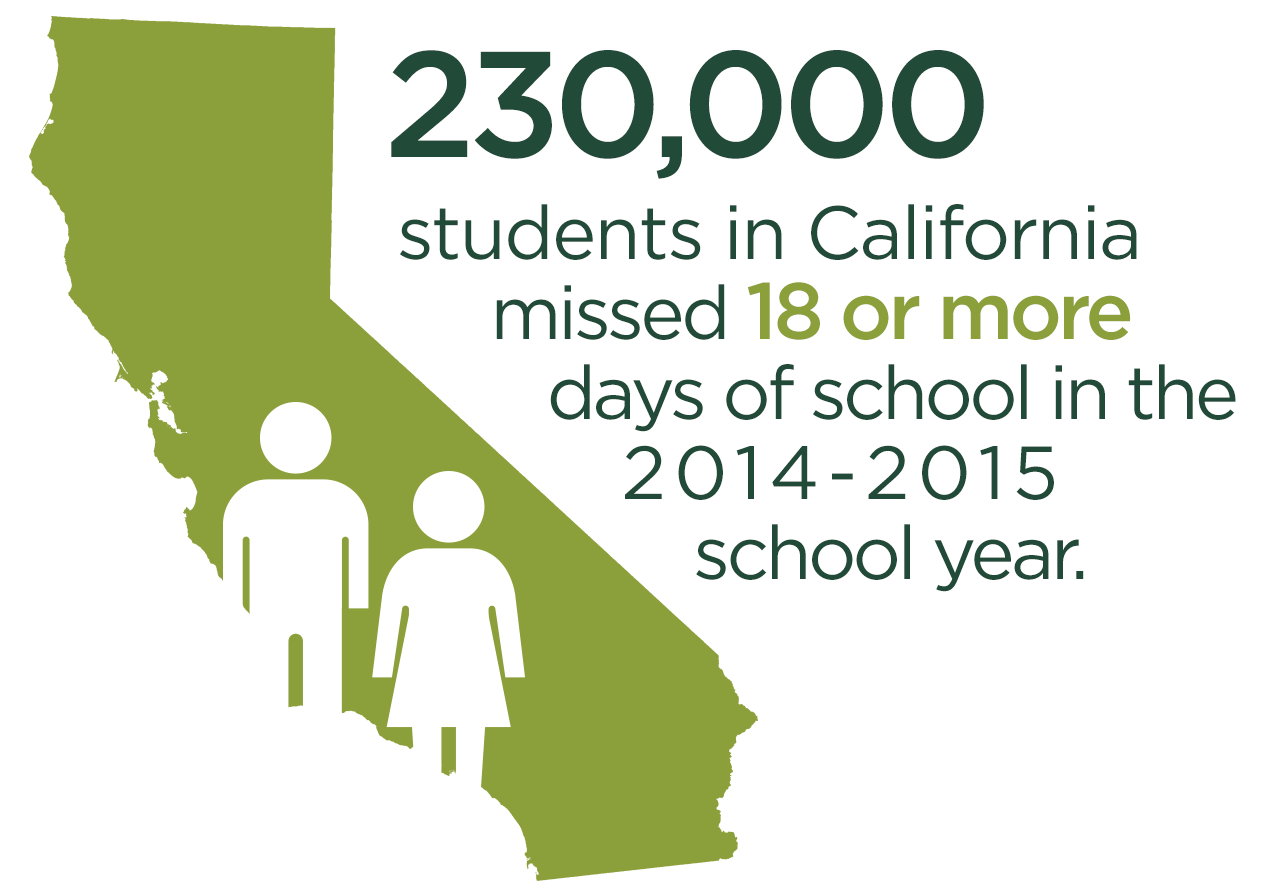
Chronic absence rates19 remain just over 8% for K-5 students, meaning that an estimated 230,000 students in California missed 18 or more days of school in the 2014-2015 school year.20 Furthermore, as many as 31,000 students in California are estimated to have missed more than 36 days of school, or 20% of the 2014-2015 school year.


Truancy rates also remain high. Data from the California Department of Education indicate that elementary truancy rates have increased slightly in the state from 21.3% in 2012-2013 to 23.2% in 2013-2014. Data from Aeries similarly suggest that the elementary school truancy rate is 23.8% for the 2014-2015 school year. However, the slight increase in truancy rates over the last three years must be interpreted with caution. Interviews with school district officials and a specialist in attendance information systems suggest that school districts have developed improved systems for tracking and monitoring truancy and chronic absence. Therefore, these increased rates may actually be an indication of better reporting rather than an increase in the number of unexcused absences in the state. Similar to previous years, elementary school truancy represents 40% of all truancy in the state.


More information in ....

https://oag.ca.gov/truancy/2015

Definition of a Truant

The California Legislature defined a truant in very precise language. In summary, it states that a student missing more than 30 minutes of instruction without an excuse three times during the school year must be classified as a truant and reported to the proper school authority. This classification and referral helps emphasize the importance of school attendance and is intended to help minimize interference with instruction. Effective January 1, 2013, the law was amended to authorize school administrators to excuse school absences due to the pupil’s circumstances, even if the excuse is not one of the valid excuses listed in the California Education Code (EC) or the uniform standards established by the governing board of the district. The EC section that defines a truant reads as follows:

EC Section 48260 (a) A pupil subject to compulsory full-time education or to compulsory continuation education who is absent from school without a valid excuse three full days in one school year or tardy or absent for more than a 30-minute period during the school day without a valid excuse on three occasions in one school year, or any combination thereof, shall be classified as a truant and shall be reported to the attendance supervisor or to the superintendent of the school district.
(b) Notwithstanding subdivision (a), it is the intent of the Legislature that school districts shall not change the method of attendance accounting provided for in existing law and shall not be required to employ period-by-period attendance accounting.
(c) For purposes of this article, a valid excuse includes, but is not limited to, the reasons for which a pupil shall be excused from school pursuant to Sections 48205 and 48225.5 and may include other reasons that are within the discretion of school administrators and, based on the facts of the pupil's circumstances, are deemed to constitute a valid excuse.

Video about Truancy


Truancy

Truancy Among Teens


Children have different rights and obligations under the law than adults. The law recognizes that children, or juveniles, are still developing, and until they reach adult age they must comply with laws that are slightly different than those which apply to adults.
One of the legal duties that the law imposes on a juvenile -- a person under the age of 18 -- is the requirement to attend school every day it is in session. A child who does not attend school on a regular basis is considered truant. Truancy is a juvenile offense that can lead to various consequences for the juvenile as well as his or her parents or legal guardian.

Missing School

States have different definitions of what it means to be truant. Typically, a student is not considered truant until he or she misses a specified number of school days without a valid excuse. For example, a state may define truancy as missing three full days of school in a single month, or 10 full days of school in a single year. States may also consider a child truant if the child is late without an excuse. For example, a child who is more than 30 minutes late for any class three or more times in a single month may be deemed truant.
More information in..
Source: http://www.criminaldefenselawyer.com/crime-penalties/juvenile/truancy.htm